
Munich Residence
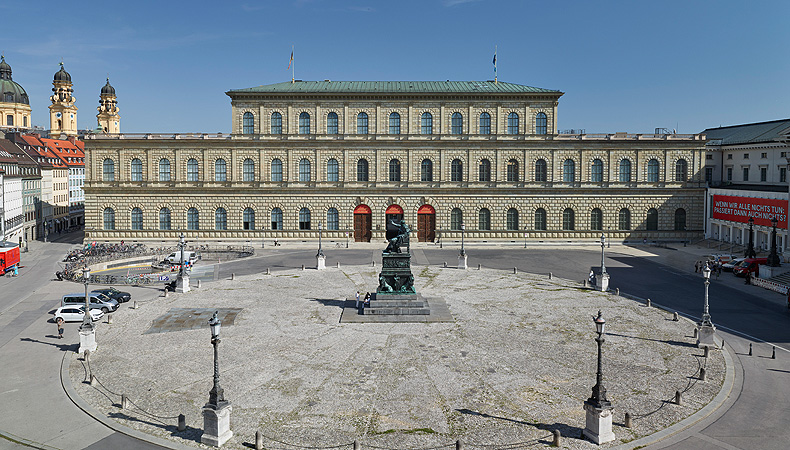
The history of the Munich court began when Duke Ludwig the Severe moved his court here from Landshut after the partition of Bavaria in 1255. As dukes, electors and finally kings, the Wittelsbachs developed their Residence from a small moated castle begun in 1385 to an extensive complex built around ten courtyards. For four centuries (until 1918) the Munich Residence was the seat of government and residence of the Wittelsbach dynasty. The palace spans the styles of four different centuries.
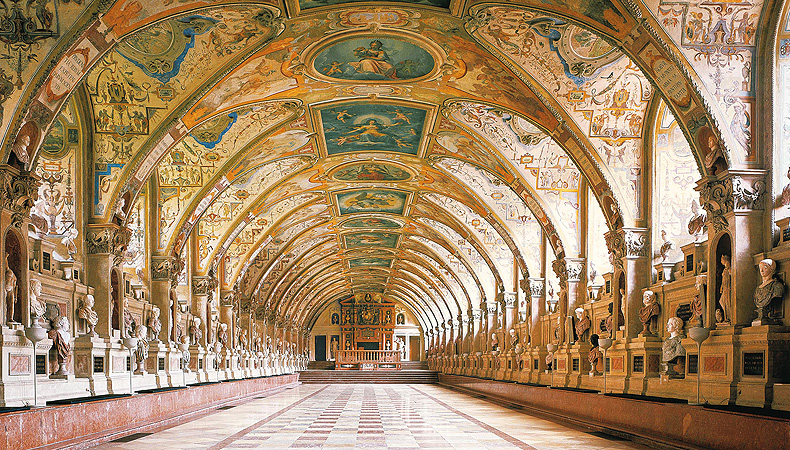
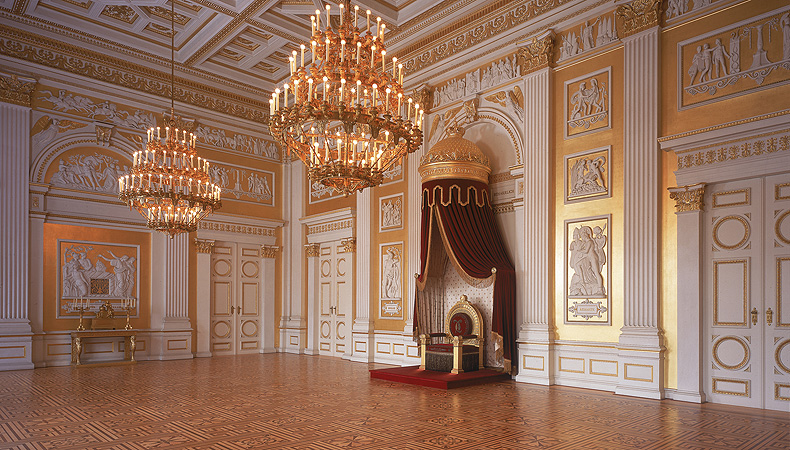
The Antiquarium is the largest Renaissance hall north of the Alps, while the symmetrical four-wing complex built by Duke Maximilian I is typical of the 17th century. The Ancestral Gallery and ‘Ornate Rooms’, designed by François Cuvilliés, are magnificent examples of the court Rococo style, and the neoclassical epoch is represented by the apartments in the Königsbau (King’s Tract, partly closed for restoration) designed by Leo von Klenze for King Ludwig I. The wall and ceiling paintings by Julius Schnorr von Carolsfeld in the Nibelungen Halls produced in the same period are the first monumental representations of the Nibelungenlied.
In addition to the rich accumulation of valuable furniture, paintings, sculptures, bronze work, clocks and tapestries, the museum rooms also contain numerous special collections
Address
Residenzstraße 1
80333 München
089 29067-1
www.residenz-muenchen.de
Opening hours
28 March-19 October:
9 am-6 pm (last entry: 5 pm)
20 October-27 March:
10 am-5 pm (last entry: 4 pm)
Open daily
Closed on: January 1, Shrove Tuesday, December 24/25/31
Guided tours
Free audio guide available in German, English, French, Italian, Spanish, Russian, Chinese, Japanese and Arabic
Guided tours of the Munich Residence, organised by the City of Munich:
Admission fees 2026
10 euros regular
9 euros reduced
Combination ticket
(Residence Museum + Treasury)
15 euros regular
13 euros reduced
Combination ticket
(Residence Museum + Treasury + Cuvilliés Theatre)
20 euros regular
16 euros reduced
Tickets for the Munich Residence are also available online in our ticket shop.
Children under 18 are admitted free of charge.
Accessibility
Getting here / parking
Munich
Underground / Suburban railway to 'Marienplatz' or 'Odeonsplatz'
Bus to 'Odeonsplatz',
tram to 'Nationaltheater'
Underground parking at 'Max-Joseph-Platz'
Further information
Free wi-fi available
Shop
Pfälzer Residenzweinstube
089 225628
Frank Weinbar
Residenzstraße 1
089 23237492,
Schumann's Bar am Hofgarten
Odeonsplatz 6/7
089 229060
Administrative office
Verwaltung der
Residenz München
Residenzstraße 1
80333 München
089 29067-1
Fax 089 29067-225
ResidenzMuenchen@ bsv.bayern.de
www.residenz-muenchen.de
